
Most homeowners pay attention to their garage door panels, rollers, tracks, and opener. However, some of the most important components are located above the garage door, where the torsion spring system does its work.
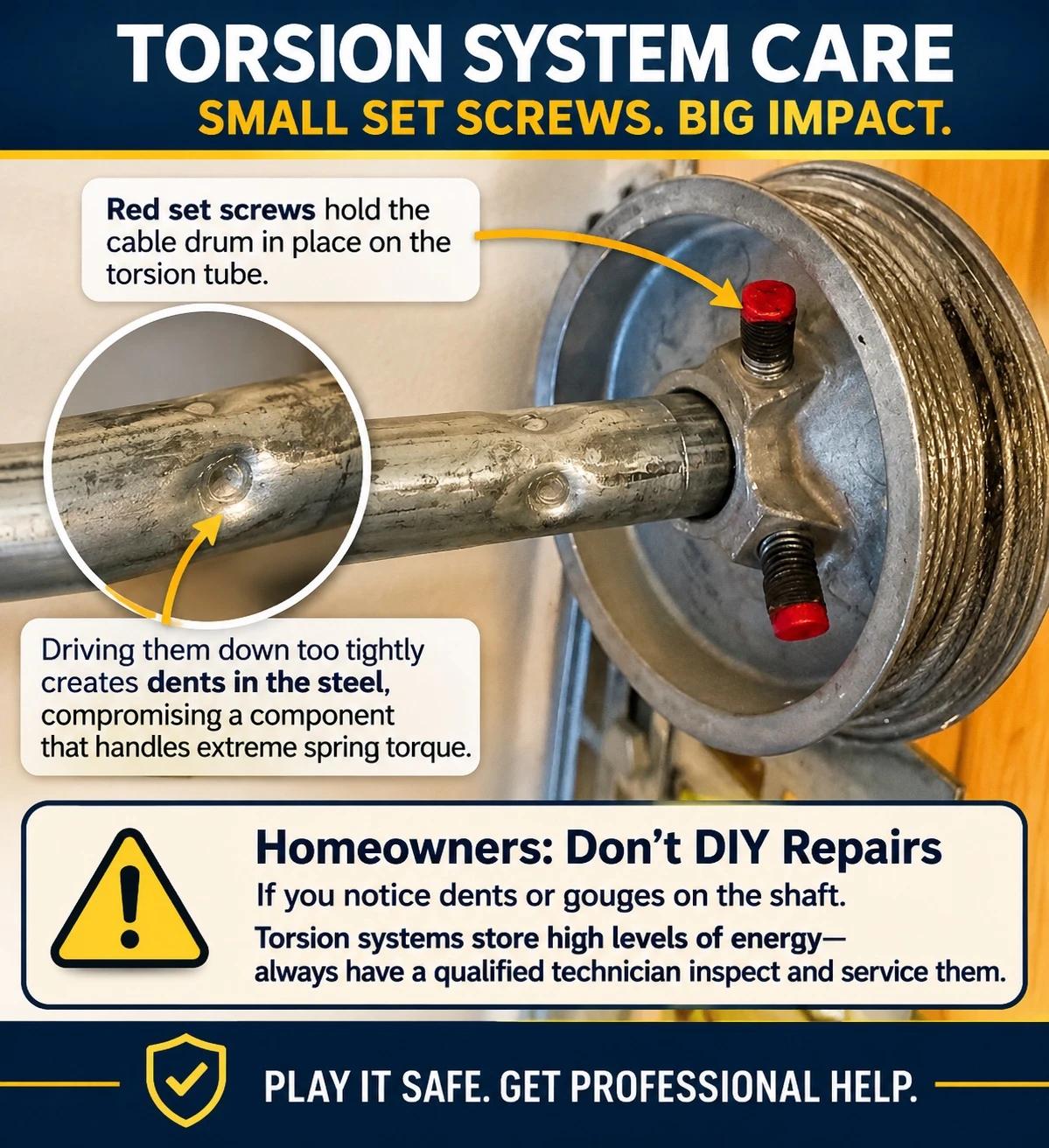
One often-overlooked component is the cable drum and the small set screws that secure it to the torsion tube.
Although these screws may look insignificant, installing or tightening them incorrectly can damage the torsion shaft and potentially affect the operation and reliability of the garage door.
Let’s look at why this matters.
1. What Are Cable Drum Set Screws?
A typical residential garage door with a torsion spring system uses a metal torsion tube positioned above the door.
At each end of this tube, you’ll generally find a cable drum. The lifting cables wrap around these drums and connect to the bottom corners of the garage door.
When the torsion springs release their stored energy, they rotate the torsion tube. The cable drums rotate with it, winding or unwinding the lifting cables and helping raise or lower the door.
The cable drums are secured to the torsion tube using small threaded fasteners called set screws.
Their purpose is simple: keep the cable drums properly secured to the shaft so the components rotate together as designed.
2. What Happens When Set Screws Are Overtightened?
This is where a seemingly minor installation mistake can become a problem.
Set screws apply pressure against the surface of the torsion tube to secure the cable drum in position.
However, applying excessive tightening force can create deep indentations, dents, or gouges in the steel shaft.
Manufacturers specifically warn against overtightening these screws.
Why is this important?
The torsion tube is an important part of the counterbalance system. It transmits rotational force between the torsion springs and cable drums.
Damaging its surface or deforming the tube can affect the fit and positioning of the components. Depending on the severity and location of the damage, the shaft may require further inspection or replacement.
A garage door installation should never rely on excessive tightening to compensate for incorrect positioning or poor component fit.
3. Why Are Dents and Gouges on the Torsion Shaft a Concern?
A torsion tube is designed to operate under substantial mechanical loads.
When set screws are driven too deeply into the steel, they can leave visible impressions or damage the shaft’s surface.
Potential concerns include:
Localized deformation: Excessive pressure can deform the steel around the set screw contact points.
Component positioning: Significant damage may affect how securely the cable drum fits against the shaft.
Repeated loading: The torsion tube experiences repeated rotational loading during normal garage door operation.
Future servicing: Existing damage may complicate proper positioning and secure attachment of replacement components.
Not every visible indentation means a shaft has failed. Some contact marks may be present from normal installation. However, deep dents, gouges, obvious deformation, or damaged components should never be ignored.
A qualified technician can determine whether the shaft remains suitable for service.
4. Warning Signs Homeowners Should Not Ignore
You don’t need to understand the entire torsion system to recognize when something might be wrong.
Pay attention to the following signs:
Visible dents or deep gouges on the torsion tube.
A cable drum that appears displaced or improperly positioned.
Garage door lifting cables that appear loose or uneven.
A garage door that moves unevenly or appears crooked.
Unusual noises coming from the upper torsion assembly.
A garage door that suddenly becomes difficult to operate.
These symptoms can have several possible causes. They do not necessarily indicate overtightened set screws, but they are good reasons to arrange a professional inspection.
5. Why You Should Never Attempt Torsion System Repairs Yourself
This is perhaps the most important part of the discussion.
Garage door torsion springs store significant mechanical energy. Even when the garage door is stationary, the springs can remain under substantial tension.
The torsion tube, cable drums, lifting cables, brackets, and associated hardware are all connected to this counterbalance system.
Attempting to loosen a set screw, reposition a cable drum, or adjust a torsion spring without the proper training and specialized tools can result in an uncontrolled release of stored energy.
This can cause serious injuries, including potentially fatal injuries.
Manufacturers such as Overhead Door explicitly instruct homeowners not to repair or adjust torsion springs, drums, cables, shafts, or related hardware.
If you notice visible shaft damage or unusual garage door operation:
Do not attempt to tighten or loosen the set screws.
Keep your hands away from the torsion assembly, cables, and drums.
Keep children and other people away from the affected area.
If the door appears damaged or is operating abnormally, stop using it and arrange a professional inspection.
Have a qualified garage door technician assess the shaft, cable drums, springs, and associated hardware.
Your safety is worth far more than attempting a DIY repair. For related spring guidance, see garage door spring safety and cable problems.
6. Proper Installation and Inspection Make a Difference
A reliable garage door system depends on more than simply installing the right components.
Correct positioning, manufacturer-specified fastening procedures, proper cable alignment, and an appropriately balanced door all contribute to safe and dependable operation.
Set screws should be tightened according to the specific manufacturer’s instructions and component specifications. There is no universal torque setting that should be applied to every cable drum and torsion tube.
During a professional inspection, a technician can assess the condition of the torsion tube, check cable drum positioning, inspect the lifting cables, and identify signs of improper installation or wear.
Addressing concerns early can help prevent more extensive mechanical problems. Browse our garage door repairs and maintenance services for how we handle inspections and counterbalance work.
Final Thoughts: Small Components Deserve Proper Attention
Garage door cable drum set screws may be small, but their role in securing the counterbalance system is important.
Overtightening them can damage the torsion shaft, while improper adjustments can create serious safety risks.
If you notice dents, gouges, or unusual movement around your garage door’s torsion assembly, don’t ignore the warning signs.
Leave torsion system repairs to qualified professionals.
Need a Garage Door Inspection?
At Everra Doors, we provide professional garage door repair, maintenance, and installation services.
Whether your garage door is making unusual noises, operating unevenly, or showing signs of mechanical damage, we’re here to help.
Everra Doors Ltd
Website: https://everradoors.com/
Phone: +1 (672) 890-2422
Serving Langley, Surrey, BC.
Your garage door’s safety starts with proper installation and maintenance. Request a quote if you need a professional inspection.